Batch Effect
This part shows how to integrate data of different batches. As integration works by adjusting the principal components, this function should be performed after PCA.
Integration
Reading data
Two batches of experiment data stored in GEM files are uesd here, which are lasso results from their original GEF file.
Please download our example data.
[1]:
import stereo as st
import warnings
warnings.filterwarnings('ignore')
[2]:
input_file_1 = '../data/SS200000132BR_A1.bin1.Lasso.gem.gz'
input_file_2 = '../data/SS200000132BR_A2.bin1.Lasso.gem.gz'

data1 = st.io.read_gem(input_file_1)
data2 = st.io.read_gem(input_file_2)
[2024-05-08 04:02:18][Stereo][244929][MainThread][140462125991744][reader][159][INFO]: the martrix has 10762 cells, and 24687 genes.
[2024-05-08 04:03:22][Stereo][244929][MainThread][140462125991744][reader][159][INFO]: the martrix has 10464 cells, and 24966 genes.
Preprocessing
Before integrating batches, we need to do basic preprocessing for each batch, including quality control and filtering.
[3]:
data1.tl.cal_qc()
data2.tl.cal_qc()
[2024-05-08 04:03:23][Stereo][244929][MainThread][140462125991744][st_pipeline][41][INFO]: start to run cal_qc...
[2024-05-08 04:03:24][Stereo][244929][MainThread][140462125991744][st_pipeline][44][INFO]: cal_qc end, consume time 0.5445s.
[2024-05-08 04:03:24][Stereo][244929][MainThread][140462125991744][st_pipeline][41][INFO]: start to run cal_qc...
[2024-05-08 04:03:24][Stereo][244929][MainThread][140462125991744][st_pipeline][44][INFO]: cal_qc end, consume time 0.5038s.
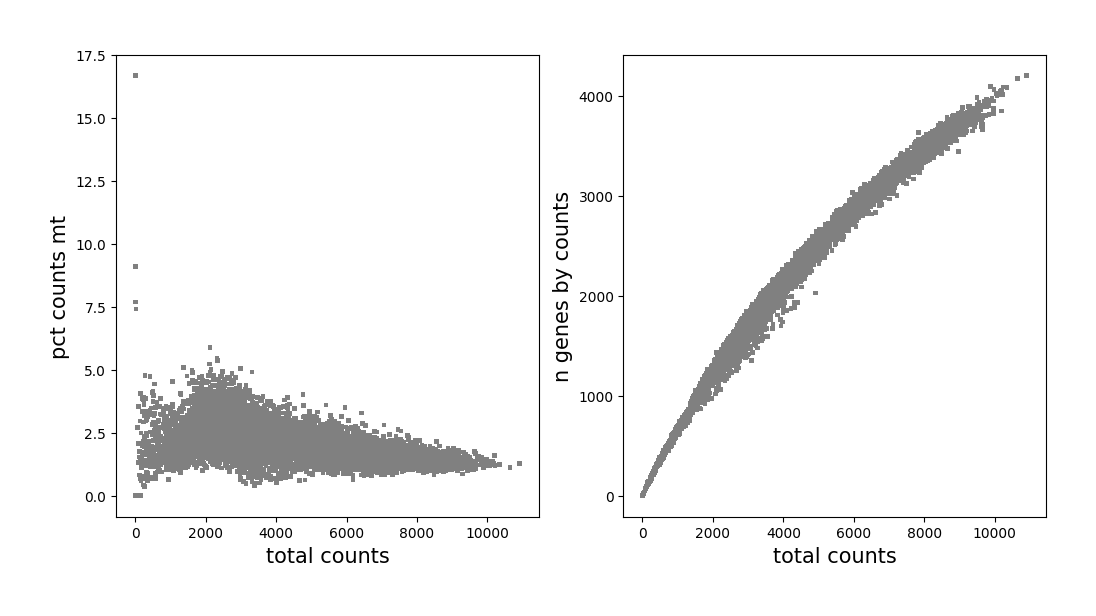
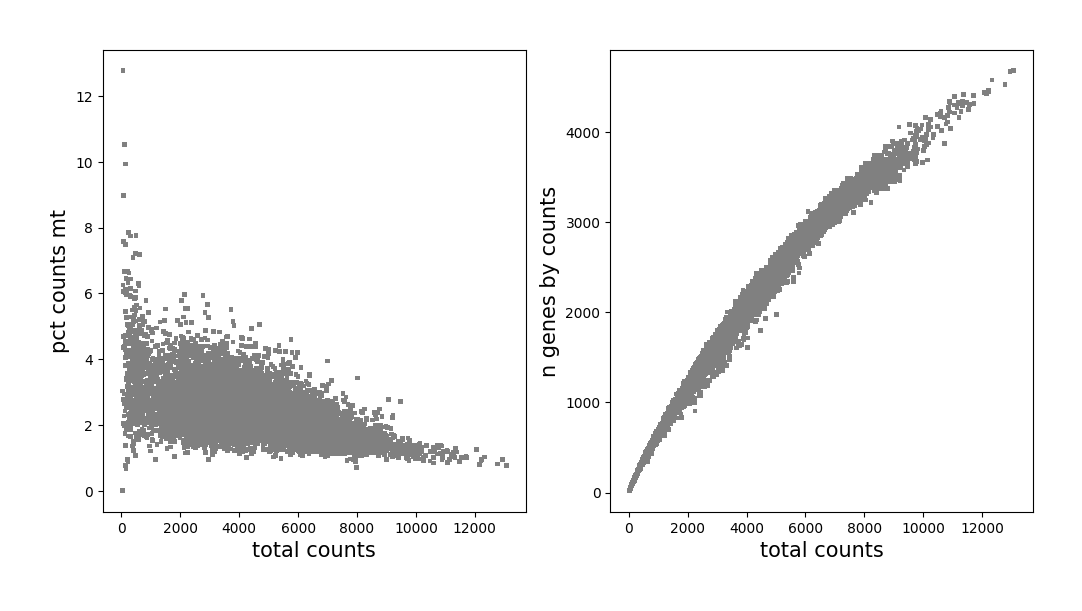
Draw scatter plots to observe the distribution, and set appropriate parameters. Filter cells or genes by st.tl.filter_cells or st.tl.filter_genes.
[4]:
# plot before filtering

data1.plt.genes_count()
[4]:
[5]:
# plot before filtering

data2.plt.genes_count()
[5]:
[6]:
# filter cells

data1.tl.filter_cells(max_n_genes_by_counts=4000, pct_counts_mt=5, inplace=True)
data2.tl.filter_cells(max_n_genes_by_counts=4500, pct_counts_mt=7, inplace=True)
[2024-05-08 04:03:25][Stereo][244929][MainThread][140462125991744][st_pipeline][41][INFO]: start to run filter_cells...
[2024-05-08 04:03:26][Stereo][244929][MainThread][140462125991744][st_pipeline][44][INFO]: filter_cells end, consume time 0.3405s.
[2024-05-08 04:03:26][Stereo][244929][MainThread][140462125991744][st_pipeline][41][INFO]: start to run filter_cells...
[2024-05-08 04:03:26][Stereo][244929][MainThread][140462125991744][st_pipeline][44][INFO]: filter_cells end, consume time 0.3792s.
[6]:
StereoExpData object with n_cells X n_genes = 10448 X 24966
bin_type: bins
bin_size: 100
offset_x = 3975
offset_y = 8625
cells: ['cell_name', 'total_counts', 'n_genes_by_counts', 'pct_counts_mt']
genes: ['gene_name', 'n_cells', 'n_counts', 'mean_umi']
result: []
Processing on MSData
Using Multi-sample data structure to process.
[7]:
from stereo.core.ms_data import MSData
from stereo.core.ms_pipeline import slice_generator

ms_data = MSData(_data_list=[data1, data2])
# you can also create ms_data by `data1 + data2`
ms_data
[7]:
ms_data: {'0': (10739, 24687), '1': (10448, 24966)}
num_slice: 2
names: ['0', '1']
obs: []
var: []
relationship: other
var_type: intersect to 0
mss: []
Normalization
Normalization should be finished before PCA. We usually run a combination of normalize_total and log1p.
[8]:
# Since normalization will change the expression matrix, save raw data beforehand.
# data.tl.raw_checkpoint()

ms_data.tl.normalize_total(scope=slice_generator[:], mode='integrate')
ms_data.tl.log1p(scope=slice_generator[:], mode='integrate')
[2024-05-08 04:03:27][Stereo][244929][MainThread][140462125991744][ms_pipeline][173][INFO]: data_obj(idx=0) in ms_data start to run normalize_total
[2024-05-08 04:03:27][Stereo][244929][MainThread][140462125991744][st_pipeline][41][INFO]: start to run normalize_total...
[2024-05-08 04:03:28][Stereo][244929][MainThread][140462125991744][st_pipeline][44][INFO]: normalize_total end, consume time 0.5252s.
[2024-05-08 04:03:28][Stereo][244929][MainThread][140462125991744][ms_pipeline][173][INFO]: data_obj(idx=0) in ms_data start to run log1p
[2024-05-08 04:03:28][Stereo][244929][MainThread][140462125991744][st_pipeline][41][INFO]: start to run log1p...
[2024-05-08 04:03:28][Stereo][244929][MainThread][140462125991744][st_pipeline][44][INFO]: log1p end, consume time 0.3146s.
PCA
[9]:
ms_data.tl.pca(scope=slice_generator[:], mode='integrate', use_highly_genes=False, n_pcs=50, res_key='pca')
[2024-05-08 04:03:28][Stereo][244929][MainThread][140462125991744][ms_pipeline][173][INFO]: data_obj(idx=0) in ms_data start to run pca
[2024-05-08 04:03:28][Stereo][244929][MainThread][140462125991744][st_pipeline][41][INFO]: start to run pca...
[2024-05-08 04:03:28][Stereo][244929][MainThread][140462125991744][dim_reduce][78][WARNING]: svd_solver: auto can not be used with sparse input.
Use "arpack" (the default) instead.
[2024-05-08 04:06:08][Stereo][244929][MainThread][140462125991744][st_pipeline][44][INFO]: pca end, consume time 159.9640s.
Integrating
Integrate data from different batches, through adjusting PCA result specified by pca_res_key, and rememer to label composite PCA result stored into res_key.
[10]:
ms_data.tl.batches_integrate(scope=slice_generator[:], mode='integrate', pca_res_key='pca', res_key='pca_integrated')
[2024-05-08 04:06:08][Stereo][244929][MainThread][140462125991744][ms_pipeline][173][INFO]: data_obj(idx=0) in ms_data start to run batches_integrate
[2024-05-08 04:06:08][Stereo][244929][MainThread][140462125991744][st_pipeline][41][INFO]: start to run batches_integrate...
2024-05-08 04:06:13,954 - harmonypy - INFO - Iteration 1 of 10
INFO:harmonypy:Iteration 1 of 10
2024-05-08 04:06:20,052 - harmonypy - INFO - Iteration 2 of 10
INFO:harmonypy:Iteration 2 of 10
2024-05-08 04:06:26,252 - harmonypy - INFO - Iteration 3 of 10
INFO:harmonypy:Iteration 3 of 10
2024-05-08 04:06:32,093 - harmonypy - INFO - Converged after 3 iterations
INFO:harmonypy:Converged after 3 iterations
[2024-05-08 04:06:32][Stereo][244929][MainThread][140462125991744][st_pipeline][44][INFO]: batches_integrate end, consume time 23.6217s.
UMAP
After integrating, we can perform UMAP base on the composite PCA result.
[11]:
ms_data.tl.neighbors(scope=slice_generator[:], mode='integrate', pca_res_key='pca_integrated', n_pcs=50, res_key='neighbors_integrated')
ms_data.tl.umap(scope=slice_generator[:], mode='integrate', pca_res_key='pca_integrated', neighbors_res_key='neighbors_integrated', res_key='umap_integrated')
ms_data.plt.batches_umap(scope=slice_generator[:], mode='integrate', res_key='umap_integrated')
[2024-05-08 04:06:32][Stereo][244929][MainThread][140462125991744][ms_pipeline][173][INFO]: data_obj(idx=0) in ms_data start to run neighbors
[2024-05-08 04:06:32][Stereo][244929][MainThread][140462125991744][st_pipeline][41][INFO]: start to run neighbors...
[2024-05-08 04:06:50][Stereo][244929][MainThread][140462125991744][st_pipeline][44][INFO]: neighbors end, consume time 18.1904s.
[2024-05-08 04:06:50][Stereo][244929][MainThread][140462125991744][ms_pipeline][173][INFO]: data_obj(idx=0) in ms_data start to run umap
[2024-05-08 04:06:50][Stereo][244929][MainThread][140462125991744][st_pipeline][41][INFO]: start to run umap...
        completed  0  /  200 epochs
        completed  20  /  200 epochs
        completed  40  /  200 epochs
        completed  60  /  200 epochs
        completed  80  /  200 epochs
        completed  100  /  200 epochs
        completed  120  /  200 epochs
        completed  140  /  200 epochs
        completed  160  /  200 epochs
        completed  180  /  200 epochs
[2024-05-08 04:07:06][Stereo][244929][MainThread][140462125991744][st_pipeline][44][INFO]: umap end, consume time 16.4866s.
[2024-05-08 04:07:06][Stereo][244929][MainThread][140462125991744][ms_pipeline][173][INFO]: data_obj(idx=0) in ms_data start to run batches_umap
[11]:
Clustering
[12]:
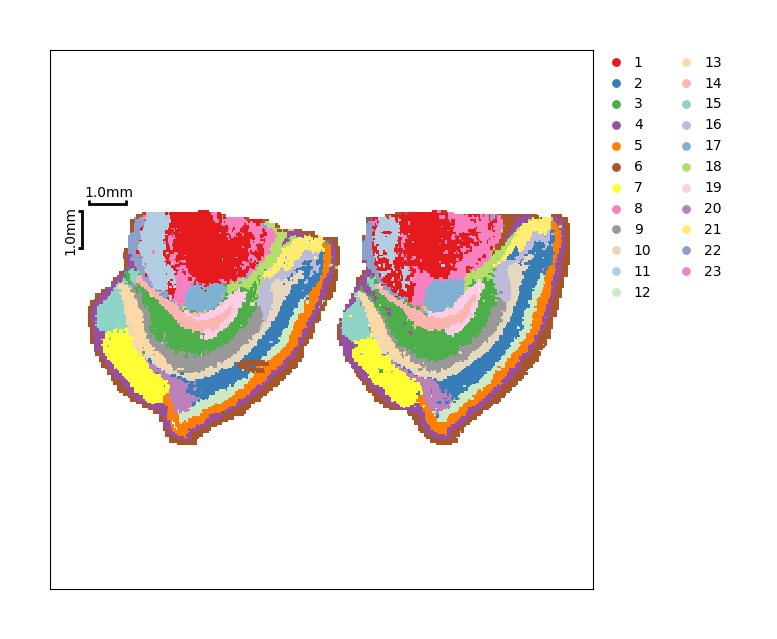
ms_data.tl.leiden(scope=slice_generator[:], mode='integrate', neighbors_res_key='neighbors_integrated', res_key='leiden')
[2024-05-08 04:07:07][Stereo][244929][MainThread][140462125991744][ms_pipeline][173][INFO]: data_obj(idx=0) in ms_data start to run leiden
[2024-05-08 04:07:07][Stereo][244929][MainThread][140462125991744][st_pipeline][41][INFO]: start to run leiden...
[2024-05-08 04:07:13][Stereo][244929][MainThread][140462125991744][pipeline_utils][27][INFO]: Can not find raw data, the data which may have been normalized will be used.
[2024-05-08 04:07:13][Stereo][244929][MainThread][140462125991744][st_pipeline][44][INFO]: leiden end, consume time 6.6618s.
[13]:
ms_data.plt.cluster_scatter(scope=slice_generator[:], mode='integrate', res_key='leiden', reorganize_coordinate=2)
[2024-05-08 04:07:13][Stereo][244929][MainThread][140462125991744][ms_pipeline][173][INFO]: data_obj(idx=0) in ms_data start to run cluster_scatter
[13]:
Note
The following part will intentionally show you the significant difference between results of after integrating and without itegrating.
Without integration
Compare the UMAP result with before for inspecting the effect of integration.
Embedding
[14]:
ms_data.tl.neighbors(scope=slice_generator[:], mode='integrate', pca_res_key='pca', n_pcs=50, res_key='neighbors', n_jobs=-1)
ms_data.tl.umap(scope=slice_generator[:], mode='integrate', pca_res_key='pca', neighbors_res_key='neighbors', res_key='umap')
ms_data.plt.batches_umap(scope=slice_generator[:], mode='integrate', res_key='umap')
[2024-05-08 04:07:14][Stereo][244929][MainThread][140462125991744][ms_pipeline][173][INFO]: data_obj(idx=0) in ms_data start to run neighbors
[2024-05-08 04:07:14][Stereo][244929][MainThread][140462125991744][st_pipeline][41][INFO]: start to run neighbors...
[2024-05-08 04:07:16][Stereo][244929][MainThread][140462125991744][st_pipeline][44][INFO]: neighbors end, consume time 2.0416s.
[2024-05-08 04:07:16][Stereo][244929][MainThread][140462125991744][ms_pipeline][173][INFO]: data_obj(idx=0) in ms_data start to run umap
[2024-05-08 04:07:16][Stereo][244929][MainThread][140462125991744][st_pipeline][41][INFO]: start to run umap...
        completed  0  /  200 epochs
        completed  20  /  200 epochs
        completed  40  /  200 epochs
        completed  60  /  200 epochs
        completed  80  /  200 epochs
        completed  100  /  200 epochs
        completed  120  /  200 epochs
        completed  140  /  200 epochs
        completed  160  /  200 epochs
        completed  180  /  200 epochs
[2024-05-08 04:07:32][Stereo][244929][MainThread][140462125991744][st_pipeline][44][INFO]: umap end, consume time 15.7857s.
[2024-05-08 04:07:32][Stereo][244929][MainThread][140462125991744][ms_pipeline][173][INFO]: data_obj(idx=0) in ms_data start to run batches_umap
[14]:
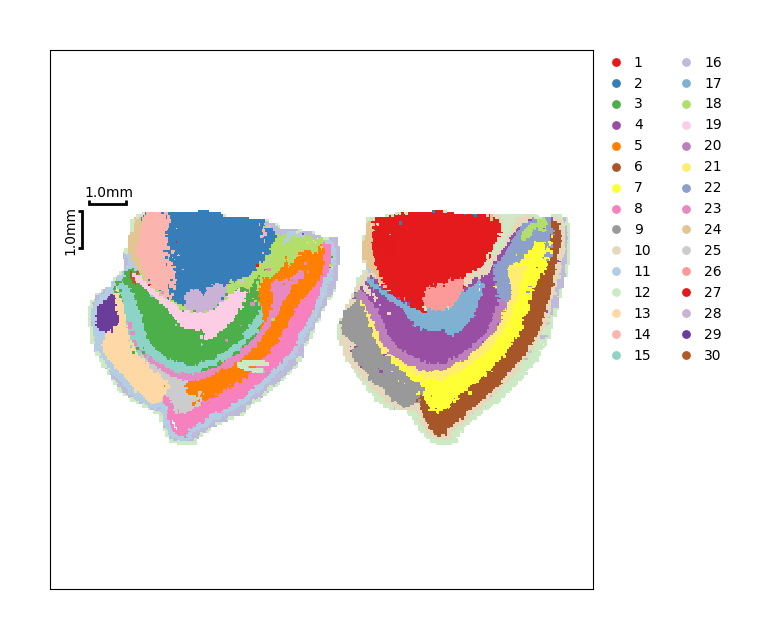
Datasets of two batches are distributed differently on UMAP space, which can be separated from each other obviously.
Clustering
We can also perform a clustering for a further comparation.
[15]:
ms_data.tl.leiden(scope=slice_generator[:], mode='integrate', neighbors_res_key='neighbors', res_key='leiden')
[2024-05-08 04:07:33][Stereo][244929][MainThread][140462125991744][ms_pipeline][173][INFO]: data_obj(idx=0) in ms_data start to run leiden
[2024-05-08 04:07:33][Stereo][244929][MainThread][140462125991744][st_pipeline][41][INFO]: start to run leiden...
[2024-05-08 04:07:42][Stereo][244929][MainThread][140462125991744][pipeline_utils][27][INFO]: Can not find raw data, the data which may have been normalized will be used.
[2024-05-08 04:07:42][Stereo][244929][MainThread][140462125991744][st_pipeline][44][INFO]: leiden end, consume time 9.4558s.
[16]:
ms_data.plt.cluster_scatter(scope=slice_generator[:], mode='integrate', res_key='leiden', reorganize_coordinate=2)
[2024-05-08 04:07:42][Stereo][244929][MainThread][140462125991744][ms_pipeline][173][INFO]: data_obj(idx=0) in ms_data start to run cluster_scatter
[16]: